
What Is Growth Marketing? A Complete Strategy Guide for B2B Companies
Growth marketing is transforming how B2B companies approach customer acquisition, engagement, and retention. This comprehensive guide breaks down the key strategies and tactics B2B marketers need to build scalable growth fueled by data, experimentation, and customer insights.
By Arwa Bombaywala
Introduction
Growth marketing has become essential for B2B businesses aiming to break through market noise and achieve sustainable expansion. Unlike traditional marketing, growth marketing combines data, agility, and continuous experimentation to deliver measurable long-term results. In this blog, you will understand what growth marketing means for B2B companies and how to build a strategy that truly drives business growth.
What is Growth Marketing?
Growth marketing is a holistic, data-informed approach to marketing that optimizes the entire customer journey, from brand awareness to conversion and retention. It focuses on rapid experimentation, learning from data, and iterating marketing tactics quickly. Especially in B2B, where sales cycles are long and decision-making is complex, growth marketing ensures every touchpoint delivers value and moves prospects closer to conversion.
The Importance of Growth Marketing for B2B Companies
Growth marketing is crucial for B2B companies for several key reasons:
- Addresses Complex Buyer Journeys: B2B sales involve multiple stakeholders and longer decision timelines. Growth marketing nurtures leads at every stage, making complex journeys more manageable and efficient.
- Drives Sustainable and Scalable Growth: Traditional campaigns may offer quick wins but lack longevity. Growth marketing builds a repeatable growth engine, combining acquisition with retention to maximize customer lifetime value.
- Lowers Customer Acquisition Costs (CAC): Through data-driven insights and funnel optimization, growth marketing reduces the spend required to attract and convert qualified leads.
- Improves Customer Retention and Loyalty: Growing a business isn’t just about new leads. Growth marketing prioritizes engagement and retention programs that reduce churn and foster loyalty, leading to more predictable revenue streams.
- Enables Data-Driven Decision Making: By leveraging analytics and testing, companies can continuously learn what works and what doesn’t, eliminating guesswork and enabling smarter investments.
- Multi-Channel Reach and Personalization: Growth marketing integrates channels like SEO, paid ads, email, social to deliver consistent, personalized experiences that resonate with prospects wherever they are.
This approach transforms marketing from a cost center into a growth driver that aligns with B2B buyers’ expectations and business goals.
Core Components of a Growth Marketing Strategy for B2B
To execute growth marketing effectively, B2B firms need to build a strategy grounded in these pillars:
- Deep Customer Understanding
- Develop detailed buyer personas and segment your market for precise targeting.
- Map out buyer pain points and decision-making factors.
- Data and Analytics
- Use analytics platforms and attribution models to track the customer journey and measure campaign effectiveness.
- Set KPIs for acquisition, engagement, retention, and revenue.
- Multi-Channel Alignment
- Integrate inbound (SEO, content marketing, email nurture) and outbound (paid ads, ABM) tactics.
- Ensure messaging consistency across channels to reinforce your value proposition.
- Experimentation and Optimization
- Establish a framework for A/B testing, rapid experimentation, and funnel optimization.
- Use customer journey insights to continuously refine campaigns and improve conversion rates.
- Personalized Customer Experiences
- Use data to personalize messaging at every touchpoint.
- Tailor communication for different segments and stages of the funnel.
- Technology and Automation
- Leverage CRM systems, marketing automation, AI-powered tools, and analytics dashboards.
- Automate repetitive tasks like lead scoring, email workflows, and social media scheduling to free resources.
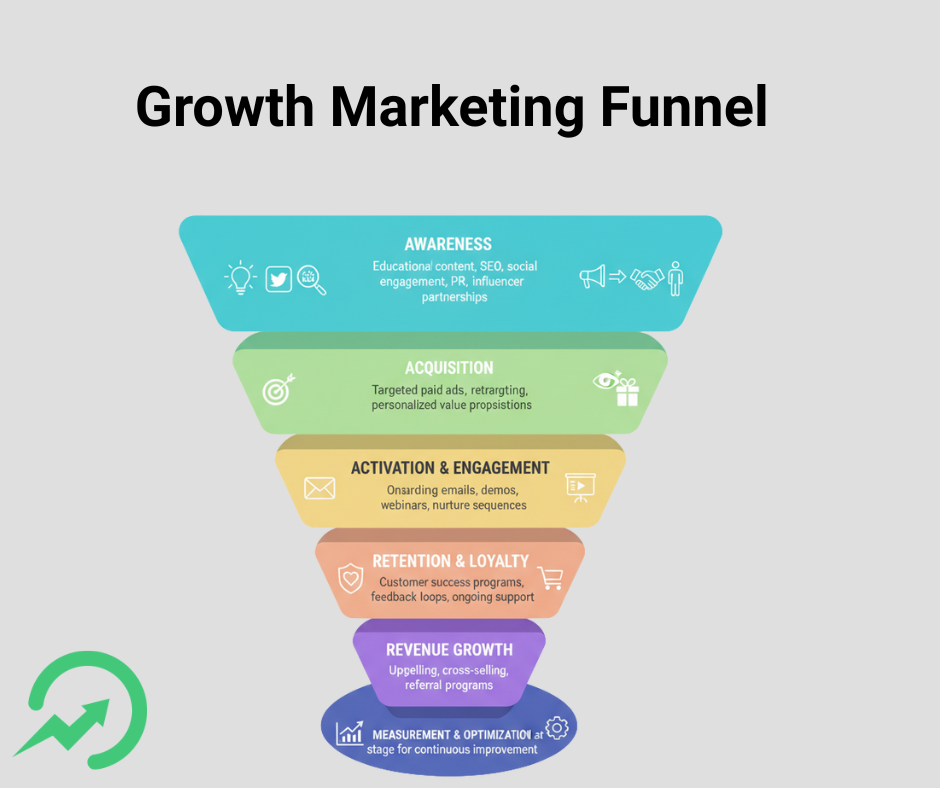
Building a Growth Marketing Funnel for B2B Companies
- Awareness: Educational content, SEO, social engagement, PR, influencer partnerships.
- Acquisition: Targeted paid ads, retargeting, personalized value propositions.
- Activation & Engagement: Onboarding emails, demos, webinars, nurture sequences.
- Retention & Loyalty: Customer success programs, feedback loops, ongoing support.
- Revenue Growth: Upselling, cross-selling, referral programs.
- Measurement & Optimization: Analyze funnel metrics at every stage for continuous improvement.
How to Get Started with Growth Marketing in Your B2B Company
- Foster an Experimental Mindset: Encourage your marketing team to embrace testing, learning, and adapting based on data rather than relying on fixed plans or intuition.
- Build or Upskill a Dedicated Team: Either form a growth marketing team or infuse growth marketing skill sets across existing marketing and sales roles to ensure collaboration.
- Choose the Right Tools: Invest in platforms that provide robust analytics, marketing automation, and CRM capabilities to enable efficient campaign execution and data transparency.
- Start with Pilot Campaigns: Launch small, focused experiments on different channels or funnel stages, setting clear hypotheses and metrics to evaluate success quickly.
- Align Sales and Marketing: Ensure seamless handoffs, shared goals, and consistent messaging so that growth efforts translate into actual revenue.
- Continuously Measure and Iterate: Use dashboards and reports to monitor KPIs closely, learn from results, and optimize campaigns in real-time to scale what works.
This step-by-step approach helps B2B firms systematically adopt growth marketing and build a repeatable engine that grows with the business.
Conclusion
Growth marketing offers B2B businesses a proven path to sustainable and scalable growth. By embracing data-driven experimentation and focusing on the entire customer lifecycle, companies can improve acquisition, retention, and revenue predictability. The time to integrate growth marketing into your strategy is now—start building your growth marketing capabilities to future-proof your business success.
Ready to Transform Your Marketing Into a Revenue Engine?
Discover how our integrated approach can deliver predictable growth in engagement, authority, and revenue for your business.