
How a B2B Marketing Agency Shapes Modern Buying Journeys
For every 1,000 website visitors, most B2B companies lose massive ARR because buyer journeys aren't intentionally designed. Modern buyers self-educate across search, LinkedIn, and peers before sales engagement, creating nonlinear paths with multiple stakeholders. This guide maps how agencies architect awareness, consideration, and decision stages to turn chaotic research into predictable revenue motion
By Arwa Bombaywala
Modern B2B buyers move through complex, self-directed journeys, and the marketing strategy needs to be designed around how they actually research, compare, and decide, not around internal org charts or legacy funnels.
The $10M Gap in Your B2B Funnel
For every 1,000 visitors hitting a typical B2B website, a significant amount of potential ARR is lost because the buyer journey isn’t intentionally designed end-to-end. Modern buyers research independently across multiple touchpoints, starting with search, LinkedIn, reviews, and peers, long before they talk to sales.
Instead of accepting stalled pipelines and leaky funnels as “normal,” the focus should be on architecting the full journey: clarifying who the ideal buyers are, how they move from problem awareness to decision, and what they need at each step to feel confident progressing.
The Modern B2B Buying Journey: Nonlinear and Buyer-Led
Today’s buyers do not move neatly from awareness to consideration to decision in a straight line. They loop between research, evaluation, and validation, often involving multiple stakeholders with different priorities.
Marketing efforts should start by documenting this real journey: which triggers start the search, which sources buyers trust, how many people are involved, and where deals typically stall. This clarity turns “random acts of marketing” into a structured experience aligned with how decisions are actually made.
Shape Awareness by Creating Visibility Where Buyers Start
Most journeys start with problem-focused questions such as “What is [pain]?” or “How to [solve challenge]?” rather than vendor names. The priority at this stage is to ensure that helpful, educational content appears wherever those questions are asked.
That means identifying topic and keyword gaps, creating problem-aware content, and distributing it consistently across channels buyers already use, such as search, LinkedIn, industry publications, and relevant communities. The goal is not just traffic, but recognition: becoming the brand buyers repeatedly encounter as they explore the problem space.
Orchestrate Consideration with Targeted Nurture and ABM
Many leads fall away in the middle of the funnel because follow-ups are generic and misaligned with what different stakeholders need to move forward. The consideration stage should be designed as a series of purposeful interactions, not a one-size-fits-all email sequence.
Here, the work is to build stage-specific and role-specific content: benchmarks, comparison guides, ROI calculators, and case studies that speak differently to economic buyers, technical evaluators, and end users. For high-value accounts, account-based motions—such as tailored content, targeted ads, and personalised experiences—help ensure that the right message reaches the right people at the right time.
A practical way to think about it:
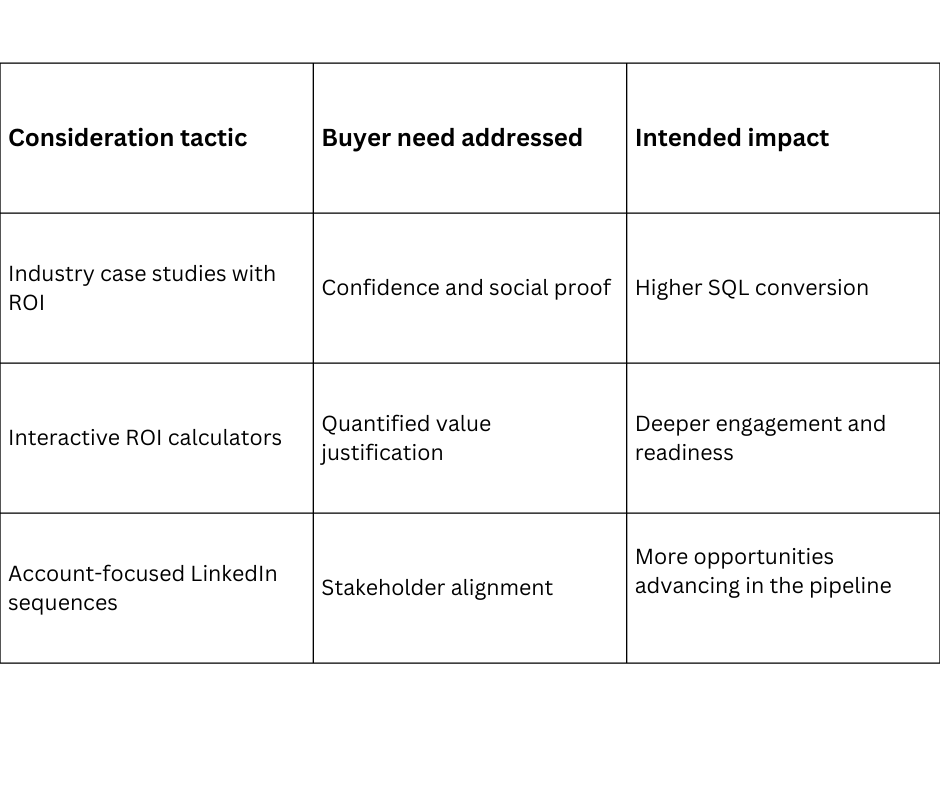
The aim is to make progress feel natural: each interaction should answer “What do I need to know now to move one step closer to a decision?”
Accelerate the Decision by Reducing Friction
High-intent buyers often stall for reasons that have little to do with desire: implementation risk, unclear pricing, security concerns, or internal consensus. The decision stage should be built to systematically address these sources of friction.
Effective steps include:
- Making trials and demos easy to access and clearly scoped.
- Providing implementation previews, timelines, and responsibilities to reduce perceived risk.
- Offering transparent pricing models or guidance, so teams can forecast internally.
- Supplying decision-support assets such as competitor comparisons, technical documentation, and stakeholder-specific FAQs.
Smooth handoffs between marketing and sales, and clear paths for buyers to ask deeper questions, help shorten cycles and increase close rates without adding pressure.
Continuously Optimize Using Data and Feedback
Designing the journey is not a one-time project. Each stage should have clear metrics - awareness (visibility and engagement), consideration (progression rates), and decision (conversion and velocity), and those metrics should be reviewed regularly.
Analytics, experimentation (such as A/B testing messages and formats), and direct buyer feedback should inform ongoing adjustments. Budgets and channel mix can then be reallocated toward the stages and tactics that consistently move the right buyers forward, ensuring the journey evolves as markets, products, and buyer expectations change.
Actionable Steps to Redesign Your Buying Journey
To put this into practice, teams can follow a simple sequence:
- Map the current journeyIdentify how buyers first discover the brand, which touchpoints they encounter, where they fall off, and what information is missing at each stage.
- Clarify ownership and collaborationDefine who is responsible for journey strategy, content creation, channel execution, and measurement, and how marketing and sales share insights.
- Prioritise the biggest bottlenecksStart where improvement will most meaningfully impact the pipeline often the mid-funnel handoff from engagement to qualified opportunity.
- Build shared dashboardsAlign on a small set of metrics for each stage and review them on a set cadence, using insights to decide what to test or refine next.
- Work in 90-day cyclesUse 90-day roadmaps to audit, pilot improvements, and then scale what works, rather than trying to reinvent everything at once.
Real-World Outcomes from Structured Journey Design
When the buyer journey is intentionally designed and managed this way, common patterns emerge: organic visibility compounds over time, nurture programs produce better-qualified opportunities instead of more noise, and decision-stage friction decreases.
Examples include:
- A mid-market SaaS business that improved organic visibility and conversion rates by aligning content and channels tightly with real buyer questions and stages.
- An enterprise tech company that reduced sales cycle length and increased deal size by tailoring mid- and late-stage experiences to buying committees and their specific concerns.
These results are not accidents; they follow from treating the buying journey as a system that can be understood, designed, and refined.
Ready to Rethink Your Buying Journey?
B2B growth increasingly belongs to companies that respect how buyers actually buy and build their marketing around that reality. The next step is to look honestly at your own journey, identify the gaps, and commit to improving one stage at a time.
If you need help building your journey, contact us at VORD
Ready to Transform Your Marketing Into a Revenue Engine?
Discover how our integrated approach can deliver predictable growth in engagement, authority, and revenue for your business.